Growing the Stack: How a UK Sales Tech Stack Grows From Founder-Led to Enterprise
Learn how to scale your B2B sales tech stack from founder-led sales to enterprise, with practical tool recommendations for CRM, data, calling, outreach, and AI.
James Donaldson
Founder @ Stakki
Questions about sales tech?
We provide neutral advice that works for you. Away from point sellers, pay to play sites and all the noise that only adds to confusion.
HubSpot from day one to enterprise. Pick the sales CRM once, set it up properly, and build everything else around it.
Most of the stack change happens at start-up stage: email gets split from calling, and the team goes phone-first.
No single tool is the best in its category. Every stage below shows options, not one winner.
Regional mobile data sits on top of your waterfall enrichment once you're selling across EMEA. It doesn't replace it.
At enterprise, the big decision for a phone-first team is TitanX or Gong. Audit what you already pay for before you buy either.
Why This Matters
Not every sales team is running AI automations that book 300 appointments a week, and most shouldn't try.
What follows is one route a typical UK B2B company might take as its sales tech stack grows: founder-led sales, a founding sales team, start-up, mid-market and enterprise. The company starts in the UK, moves into EMEA, then goes global. HubSpot stays the CRM the whole way through.
None of this is theory. It's drawn from the 150+ sales stacks we've worked on, seen first hand, or talked through with guests on Build with Stakki, our YouTube series.
The reason the whole thing leans phone-first is simple. 20% of your top performers make 80% of your revenue, and they do it phone-first, on single-line dialling. Credit to Gerry Hill for showing me the data that backs this up. It's the unsexy answer, but it's the one that keeps showing up.
One caveat before we start. There are the right tools for the right use cases, and your use case will differ. Target personas, how much coaching you can give and how hard, TAM size, investor pressure, timeframes and your appetite for risk all change the answer. Treat this as a map, not a rulebook.
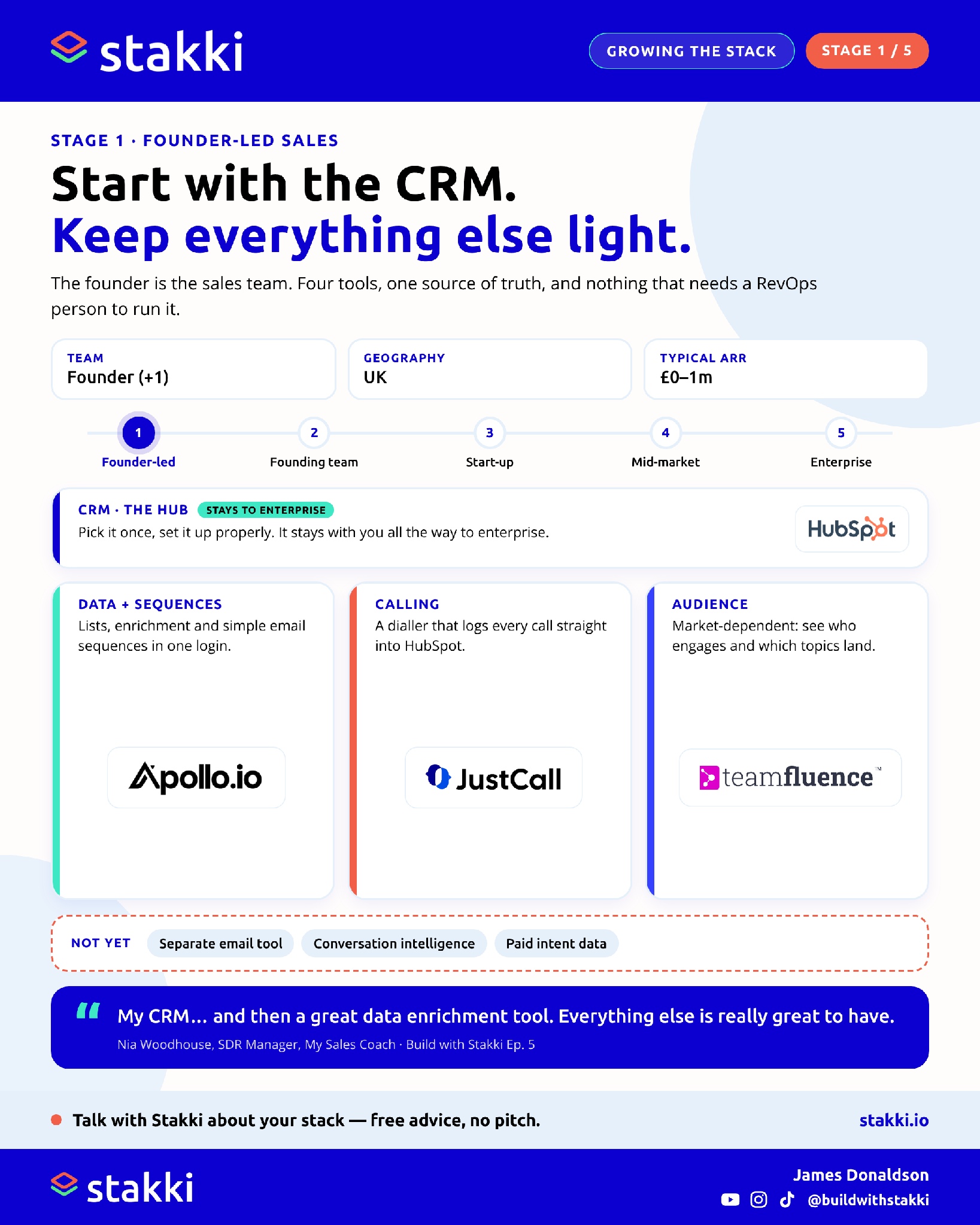
Stage 1: Founder-Led Sales
Start with the CRM. Keep everything else light.
Team: the founder, maybe one more. Geography: UK. Typical ARR: £0 to £1m.
The founder is the sales team. You want four tools, one source of truth, and nothing that needs a RevOps person to run it.
CRM: HubSpot. Pick it once and set it up properly. In this story it never changes.
Data and sequences: Apollo. Lists, enrichment and simple email sequences in one login.
Calling: JustCall. A dialler that logs every call straight into HubSpot.
Audience: Teamfluence. Depending on your market, it shows who's engaging with your content and which topics land.
What you don't need yet: a separate email tool, conversation intelligence, or paid intent data. Often we just reshape the CRM before we even look at any of the tools.
Nia Woodhouse, SDR Manager at My Sales Coach, put it well on Build with Stakki Ep. 5. The must-haves are "my CRM… and then a great data enrichment tool. Everything else is really great to have."
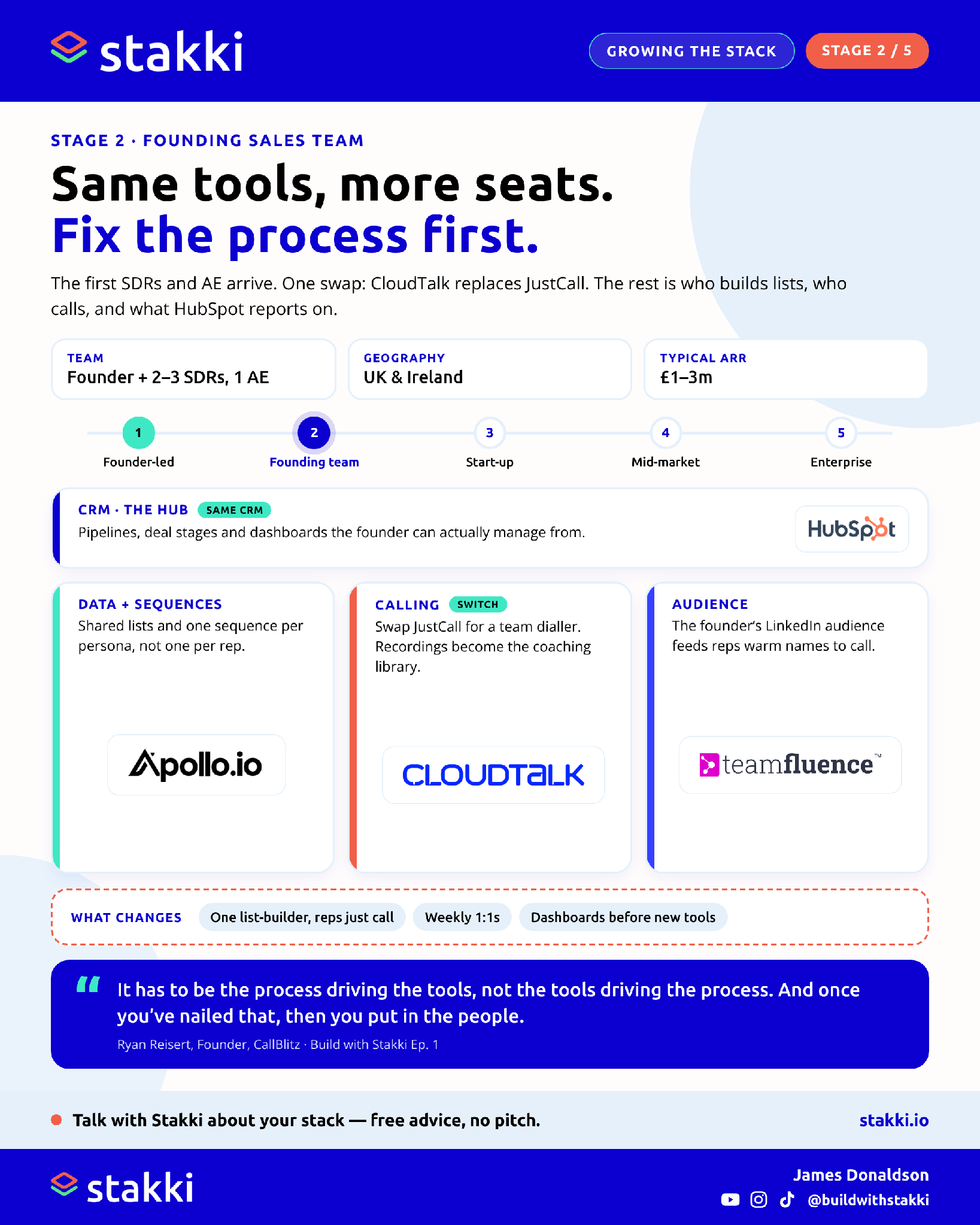
Stage 2: The Founding Sales Team
Same tools, more seats. Fix the process first.
Team: the founder plus 2 to 3 SDRs and an AE. Geography: UK and Ireland. Typical ARR: £1m to £3m.
The temptation when you hire your first reps is to buy more software. Don't. Not yet. There's one swap worth making: CloudTalk replaces JustCall, giving you a proper team dialler that will carry you into EMEA. Call recordings become your coaching library from day one.
Everything else stays. HubSpot gets proper pipelines, deal stages and dashboards. Apollo moves to shared lists and one sequence per persona, not one per rep. The founder's audience, tracked in Teamfluence, feeds reps warm names to call.
What actually changes is the process:
One person builds lists, so reps can just call
Weekly 1:1s, kept separate from pipeline reviews
Dashboards before new tools
Ryan Reisert, Founder of CallBlitz, said it on Ep. 1: "It has to be the process driving the tools, not the tools driving the process. And once you've nailed that, then you put in the people."
His numbers back it up. When reps build their own lists, the average rep makes about 40 dials a day. Give them a dedicated list-builder and they're having 40 to 60 conversations a day. Building a new list doesn't miraculously create you more pipeline. Calling it properly does.
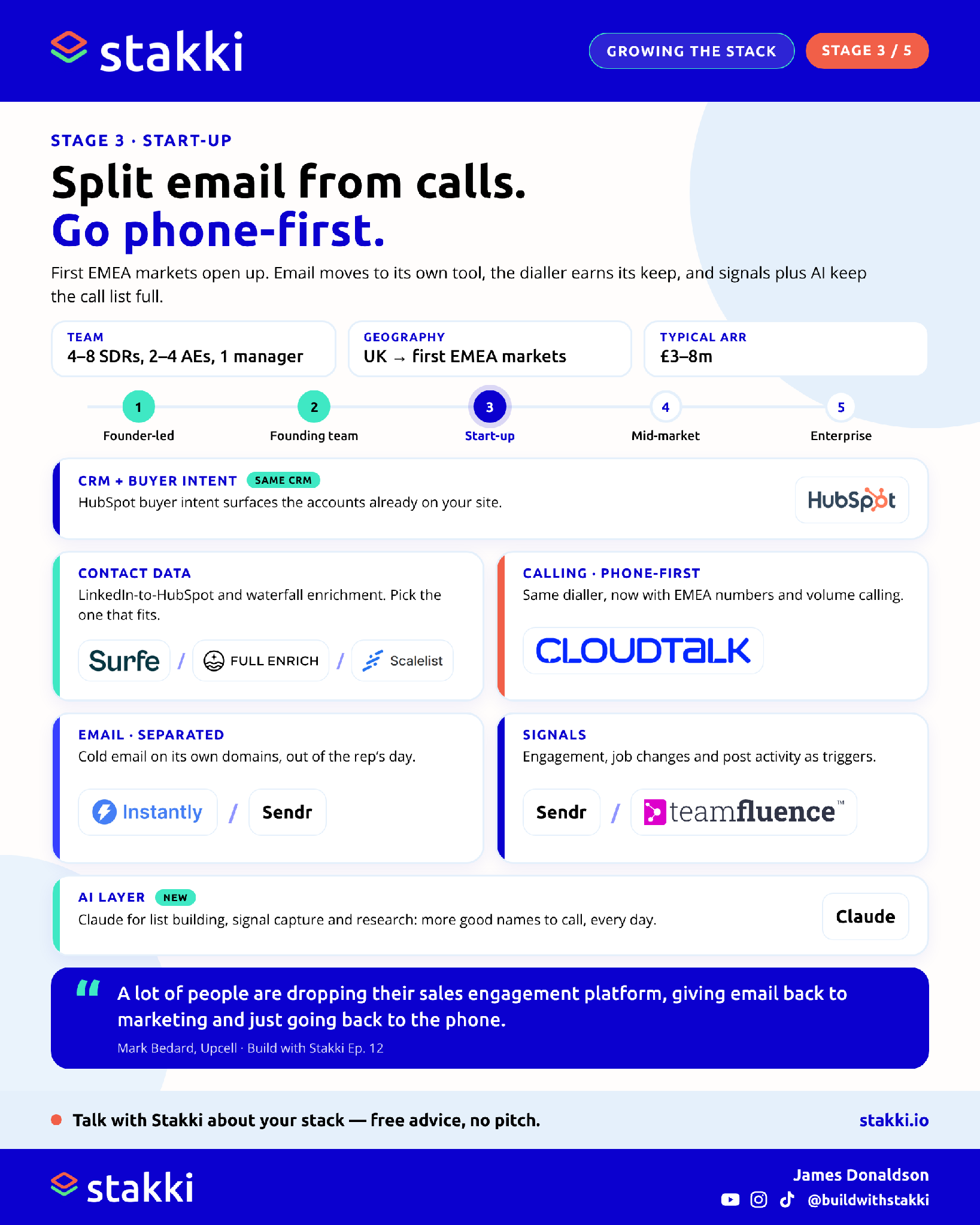
Stage 3: Start-Up
Split email from calls. Go phone-first.
Team: 4 to 8 SDRs, 2 to 4 AEs and a first sales manager. Geography: UK, plus the first EMEA markets. Typical ARR: £3m to £8m.
This is the stage where most stacks change shape, and it should. Three moves matter.
1. Split Email From Calls
Cold email moves to its own tool, Instantly or Sendr, on its own domains and out of the rep's day. Reps stop babysitting sequences.
Mark Bedard of Upcell said it on Ep. 12: "A lot of people are dropping their sales engagement platform, giving email back to marketing and just going back to the phone." On Ep. 19, Surfe's David Chevalier described the same split in practice. Instantly handles their ABM and marketing email, separate from the reps' own sequences.
2. Go Phone-First
CloudTalk, brought in at stage 2, now adds EMEA numbers and volume calling. For contact data, there's no single best tool. Surfe, FullEnrich or Scalelist: pick the one that fits your market and your workflow.
3. Feed the Phones
HubSpot buyer intent surfaces the accounts already on your website.
Sendr or Teamfluence turn engagement, job changes and post activity into triggers.
Claude handles list building, signal capture and research, so reps start every day with more good names to call.
One warning. Signals should help reps prioritise their time. They don't mean you ignore the rest of the list and sit there waiting for signals. Keep dialling.
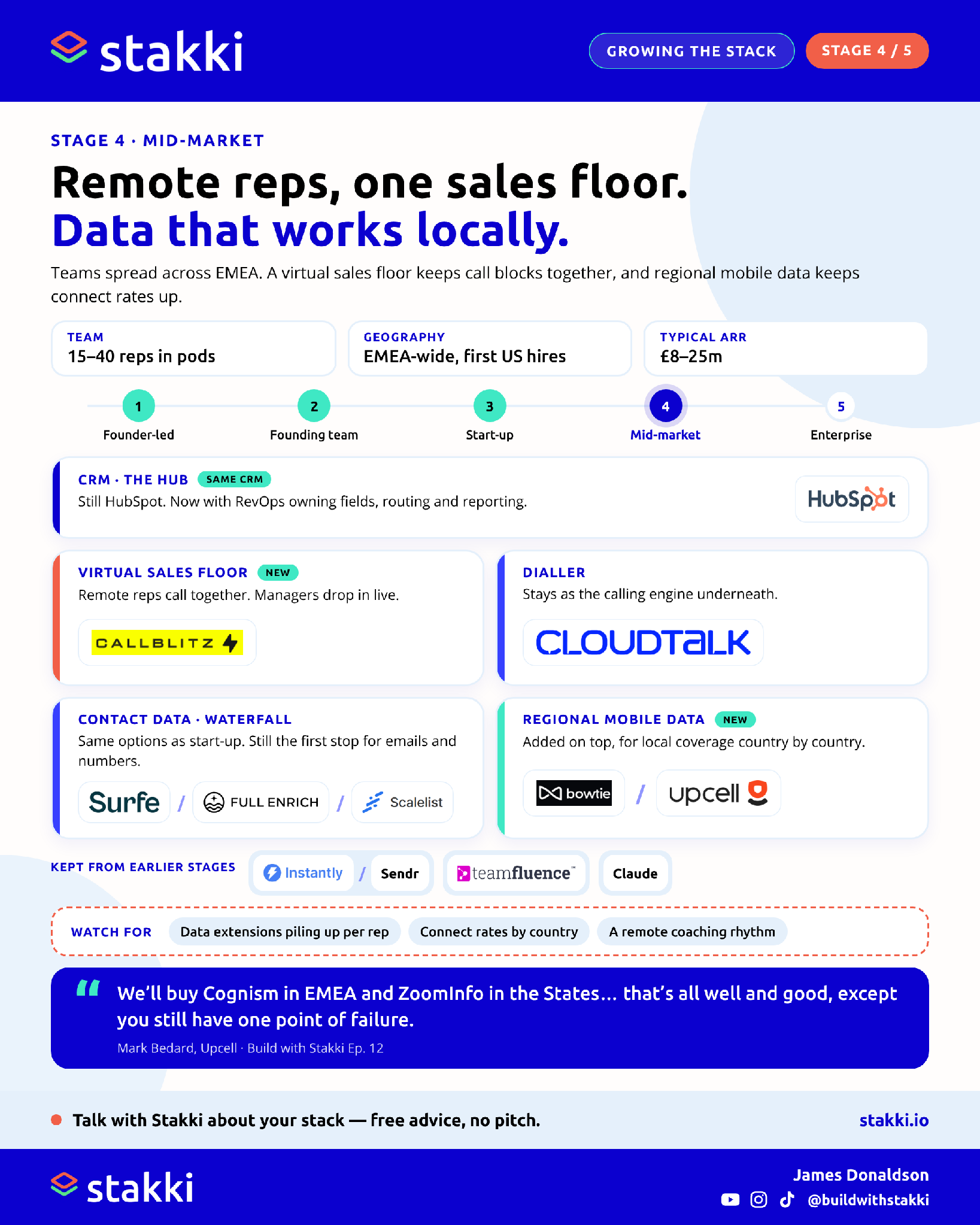
Stage 4: Mid-Market
Remote reps, one sales floor. Data that works locally.
Team: 15 to 40 reps in pods. Geography: EMEA-wide, with the first US hires. Typical ARR: £8m to £25m.
Two problems show up together here: keeping a remote team calling together, and keeping connect rates up in every country.
Virtual sales floor: CallBlitz. Remote reps call together and managers drop in live. CloudTalk stays as the calling engine underneath. Ryan Reisert told us the teams using it all day "have doubled or tripled their team's activities."
Waterfall enrichment: Surfe, FullEnrich or Scalelist. Same options as start-up, still the first stop for emails and numbers.
Regional mobile data: Bowtie or Upcell. Added on top of the waterfall, not instead of it, because UK, DACH and Nordics coverage is never the same from one provider.
Mark Bedard put the data problem plainly on Ep. 12: "We'll buy Cognism in EMEA and ZoomInfo in the States… that's all well and good, except you still have one point of failure."
Instantly or Sendr, Teamfluence and Claude all stay. HubSpot is still the hub, with RevOps now owning fields, routing and reporting.
What to watch for at this stage:
Data extensions piling up per rep.Surfe's David Chevalier has seen five different Chrome extensions on a single SDR's browser.
Connect rates tracked by country, not as one average.
A remote coaching rhythm that actually happens.
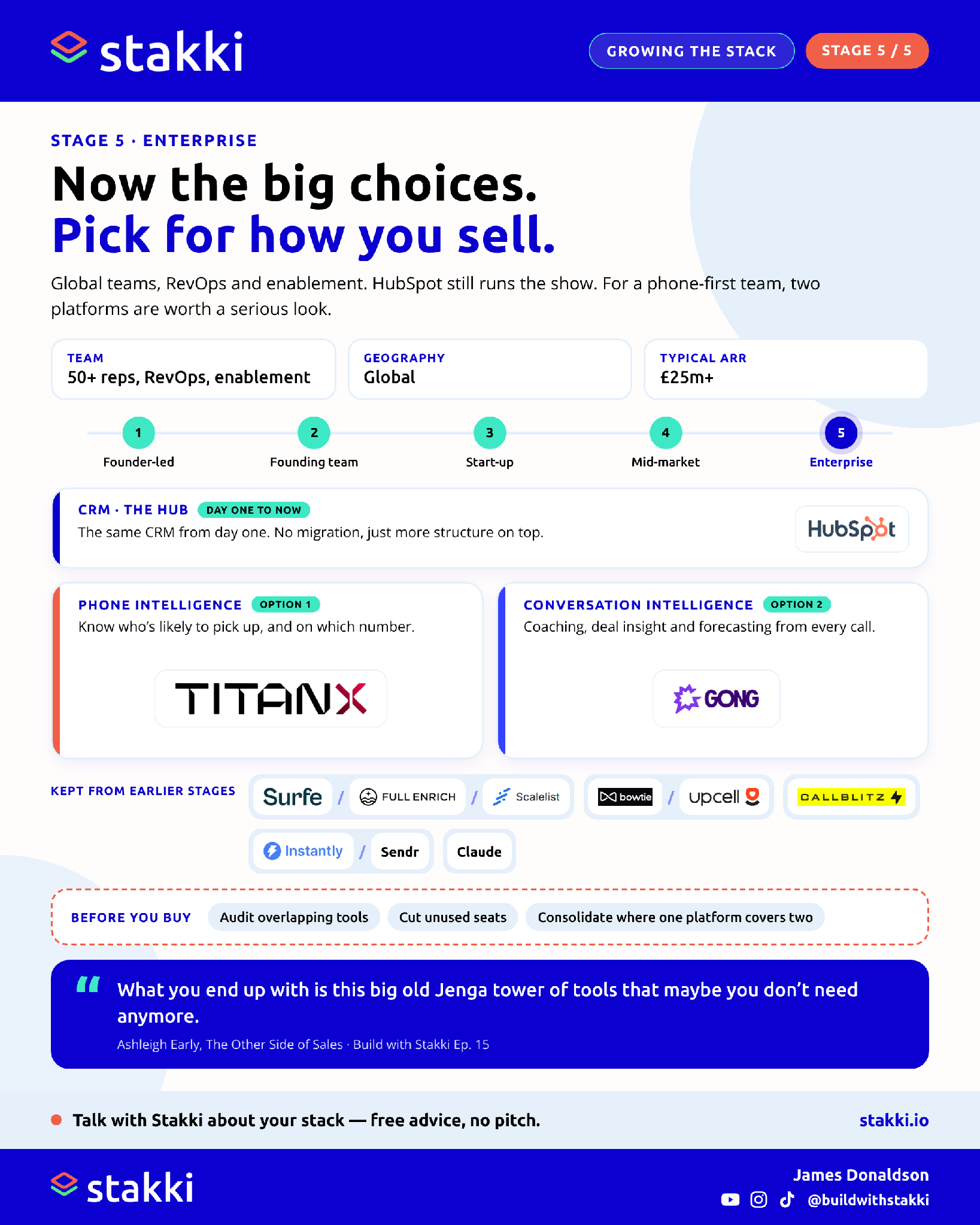
Stage 5: Enterprise
Now the big choice. Pick for how you actually sell.
HubSpot is still the CRM. No migration, just more structure on top. For a phone-first team, this is where a serious platform decision comes up:
Option 1: TitanX. Phone intelligence. Know who's likely to pick up, and on which number.
Option 2: Gong. Conversation intelligence. Coaching, deal insight and forecasting from every call.
You probably don't need both. The right pick depends on where your bottleneck is: getting connects, or coaching what happens once you do. If you're hell bent on buying one, you need to know what problem you're actually solving.
Before you buy, do the unglamorous bit:
Audit overlapping tools
Cut unused seats
Consolidate where one platform covers two
Ashleigh Early of The Other Side of Sales described what happens if you skip it, on Ep. 15: "What you end up with is this big old Jenga tower of tools that maybe you don't need anymore." In one 500-seller stack she found Demandbase and 6sense running side by side. "A straight double up."
Team sizes and ARR bands are illustrative, not thresholds.
The Stakki Recommendation
Start with the CRM, find the bottleneck, then add the tool. In that order, every time.
If I had to boil the whole series down, it's this. Get HubSpot right first. Then fix your data, then your dialler, then call behaviour. Only after that should you look at conversation intelligence and AI on top.
I'm a very simple, cold call a list really well before you add anything else kind of person. It's become kind of unsexy to say, but the answer is often more good conversations, not more tools.
These are tools we recommend regularly and use ourselves. Other options may suit your market better, and enterprise teams or very early start-ups may need something different.
Factors to Consider Before You Copy This
The stages are a map. These five things decide your actual route.
Target personas
Who you sell to decides your channels. Personas who live on their phones and personas who only answer email need different stacks.
Coaching availability and intensity
A phone-first team without coaching is just a loud team. If no one has time to listen to calls, conversation intelligence won't fix that.
TAM size
A small TAM means every account matters, so data quality and signals earn their keep earlier. A huge TAM can carry more volume and simpler tooling for longer.
Investor pressure and timeframes
A board that wants pipeline next quarter pushes teams to buy before the process is ready. That's how the Jenga tower starts.
Appetite for risk
Some teams will happily test a new tool on a pod. Others need it proven first. Both are fine, as long as you know which one you are.
FAQs
Do I need to change CRM as I scale?
Not in this story. HubSpot carries the company from founder-led to enterprise. Most of the work is reshaping it as the team grows, not replacing it.
Why phone-first?
Because 20% of top performers make 80% of revenue, and they do it phone-first, on single-line dialling. Credit to Gerry Hill for the data behind that.
Why show several tools in one category?
Because no one tool is the best in its field. Surfe, FullEnrich and Scalelist all do a strong job. The right one depends on your market, workflow and budget. We’ve shown you some of the best options wherever you see the / symbol.
Is regional mobile data a replacement for my enrichment tool?
No. Bowtie or Upcell sit on top of your waterfall. One provider per region still leaves you with one point of failure.
When should I buy TitanX or Gong?
When you know your bottleneck. Connect rates point to TitanX. Coaching and deal insight point to Gong. You probably don't need both on day one.
Where does AI fit?
At start-up stage, Claude does the heavy lifting on list building, signal capture and research, so reps have more good names to call. It feeds the phones. It doesn't replace them.
👉 Want a second opinion on your stack? Talk with Stakki. It's free advice, no pitch.




.png)


